
How to Check Your Blood Pressure at Home Without Getting Misleading Readings
Home blood pressure readings are only useful when the technique is right. Here is how to choose a monitor, sit correctly, avoid common mistakes, and keep readings your doctor can actually use.
- ✓Use a validated upper-arm monitor where possible.
- ✓Rest for 5 minutes, keep your feet flat, and support your arm at heart level.
- ✓Take 2 readings 1-2 minutes apart and record the average.
- ✓Don't compare readings taken at different times or under different conditions.
Small home blood pressure mistakes can make your reading look worse than it is
Even with a good monitor, everyday mistakes can change the result: talking during the reading, crossing your legs, using the wrong cuff size, or checking over clothing. Any of these can add 5-50 mmHg.
That can be the difference between a normal reading and a hypertension range reading. It can be the difference between calm and panic. It can also be the difference between your doctor adjusting your medication and your doctor simply asking you to check again properly.
Here is how to check your blood pressure correctly at home: what to buy, how to sit, what to avoid before checking, and how to keep a log that is useful at your next appointment. For the broader blood pressure routine, also read our comprehensive guide for managing high blood pressure.
The best blood pressure monitor for home use is usually an upper-arm device
Why upper-arm blood pressure monitors are more reliable than wrist monitors
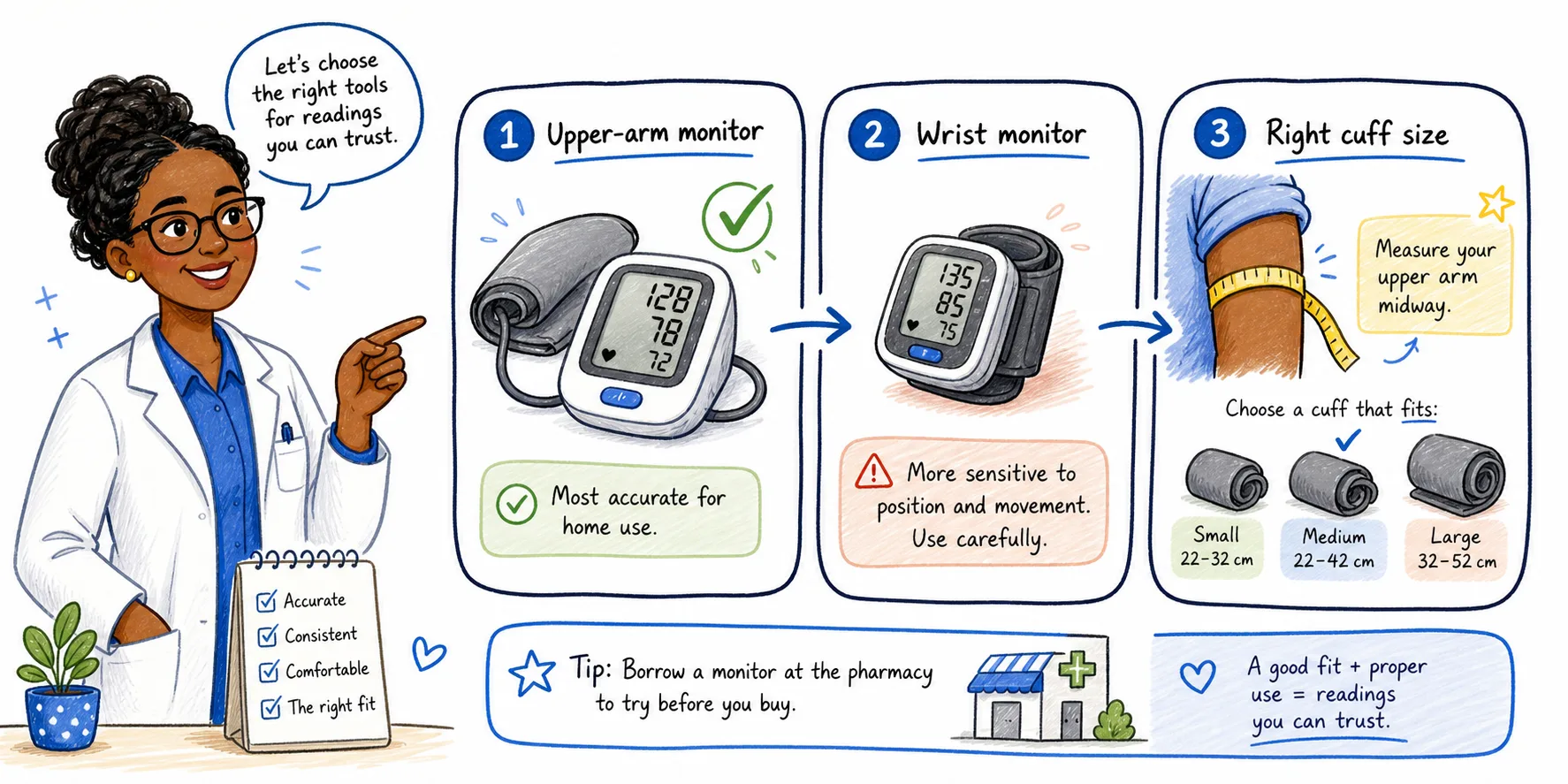
Upper-arm blood pressure monitors are more accurate than wrist monitors. The American Heart Association, the European Society of Hypertension, and the Nigerian Hypertension Society all recommend upper-arm devices for home monitoring. Wrist monitors are more convenient but less reliable because the wrist is farther from the heart and more sensitive to position.
In Nigeria, validated brands include Omron, Microlife, and A&D. These brands have models that have passed clinical validation protocols from the British Hypertension Society, the European Society of Hypertension, or the Association for the Advancement of Medical Instrumentation. When you're buying a monitor, look for validation claims on the packaging or ask the pharmacist which models have been tested for accuracy.
How to choose the right blood pressure cuff size for your arm
A cuff that doesn't fit your arm will give inaccurate readings. A cuff that's too small makes your blood pressure appear higher than it is. A cuff that's too large makes it appear lower.
Standard cuffs fit arm circumferences of 22-32 cm. If your arm is larger or smaller than this, you need a different size. To measure your arm, wrap a tape measure around the middle of your upper arm, halfway between your shoulder and your elbow. If you're unsure, ask a pharmacist or clinic staff to measure your arm and recommend the right cuff.
Cuff size isn't a small detail. A 2023 JAMA Internal Medicine trial found that using a regular cuff when a different cuff size was needed produced clinically meaningful errors. When the cuff was too small, readings were falsely higher. When it was too large, readings were falsely lower.
Where to buy a validated blood pressure monitor in Nigeria
Blood pressure monitors are available through many pharmacies and medical supply stores across Nigeria. Digital BP monitors can cost about ₦24,450 to ₦114,150, depending on the brand and features. Some models include memory for multiple readings, irregular heartbeat detection, and Bluetooth connectivity for smartphone apps.
If you're buying online, purchase from a reputable pharmacy or medical supply store. Avoid unbranded or heavily discounted monitors from unknown sellers because they may not have been validated for accuracy.
What to avoid before checking your blood pressure at home
What you do in the 30 minutes before checking matters as much as how you check. These pre-check rules are based on clinical guidelines from the American Heart Association and the European Society of Hypertension.
Don't consume caffeine, smoke, or exercise for 30 minutes before checking. Caffeine and nicotine both cause temporary rises in blood pressure. Exercise can keep your reading higher for up to 30 minutes after you finish. If you've had coffee, tea, cola, or an energy drink, wait before measuring.
Use the bathroom first. A full bladder can raise your blood pressure by 10-15 mmHg. This is one of the most common and most overlooked sources of error in home monitoring.
Rest for 5 full minutes before checking. Sit quietly in a comfortable chair with your back supported and your feet flat on the floor. Don't check immediately after walking, climbing stairs, or feeling stressed. Give your body time to settle.
Avoid checking immediately after a heavy meal. Digestion increases blood flow to the stomach and can temporarily affect blood pressure. Wait at least 30 minutes after eating.
Don't talk during the reading. Even casual conversation raises blood pressure. A study in Blood Pressure Monitoring found that talking during measurement increased systolic pressure by an average of 10-15 mmHg. Stay silent from the moment the cuff starts inflating until it fully deflates.
The correct sitting position for an accurate blood pressure reading
Small errors in body position add up to big errors in readings. Do it like this:
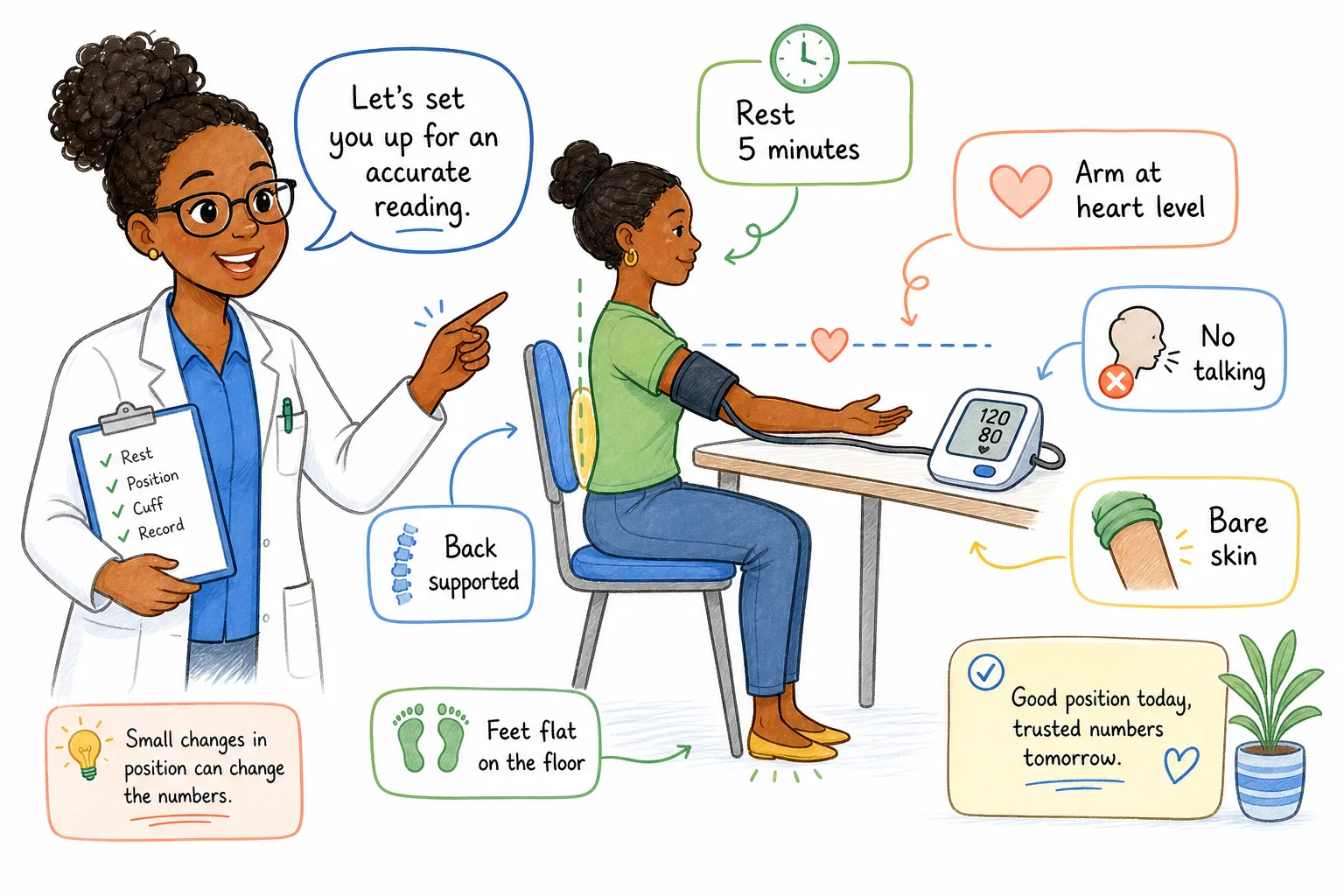
Sit in a chair with back support. Don't sit on a sofa or bed, where you may sink into a slouched position. Your back should be straight and supported.
Keep your feet flat on the floor. Don't cross your legs. Crossing your legs at the knee can raise your systolic pressure by 2-8 mmHg. Keep both feet on the floor.
Rest your arm on a table or armrest at heart level. The cuff should be at the same height as your heart. If your arm hangs down, gravity increases the pressure in the vessels of your arm and the reading will be artificially high. If your arm is held above your head, the reading will be artificially low. Use a table or sturdy armrest to support your arm comfortably.
Place the cuff on bare skin, not over clothing. A thin sleeve might seem harmless, but studies have shown that even a light shirt can add 5-50 mmHg to the reading. Roll up your sleeve or remove your shirt to expose the upper arm.
Position the cuff correctly. The bottom edge of the cuff should sit about 2-3 cm above the bend of your elbow. The cuff should be snug but not tight. You should be able to fit one finger under the cuff.
Relax your hand. Don't make a fist or grip the armrest tightly. Your hand should rest gently, palm up or palm down, whichever is comfortable.
How to take and record a blood pressure reading your doctor can trust
Once you're positioned correctly, follow this routine:
1. Press start and remain completely still. Don't move your arm, shift in your seat, or talk. Any movement during inflation or deflation can disrupt the reading.
2. Wait for the monitor to complete the full cycle. Most monitors take 30 to 60 seconds. Resist the urge to move or check your phone.
3. Record the first reading, then wait 1-2 minutes and take a second reading. The first reading in a session is often slightly higher because the act of checking can make you more alert or anxious. The second reading is usually more useful.
4. Average the readings. Don't pick the lowest number. Don't pick the highest. Average the 2 readings and use that as your reading for the session.
5. Write it down immediately. Don't trust your memory. Note the date, time, both numbers, which arm you used, and any relevant context: whether you had caffeine, how you slept, whether you felt stressed, and whether you took your medication on time.
If you get a reading that seems very different from your usual range, rest for 5 minutes and check again. If the second reading is similar to the first, record both. If it's very different, take a third reading and average the 2 that are closest together.
How often to check blood pressure at home and what to record
Reliable data comes from routine, not from checking whenever you feel worried. A simple schedule is better than 6 anxious checks in one day.
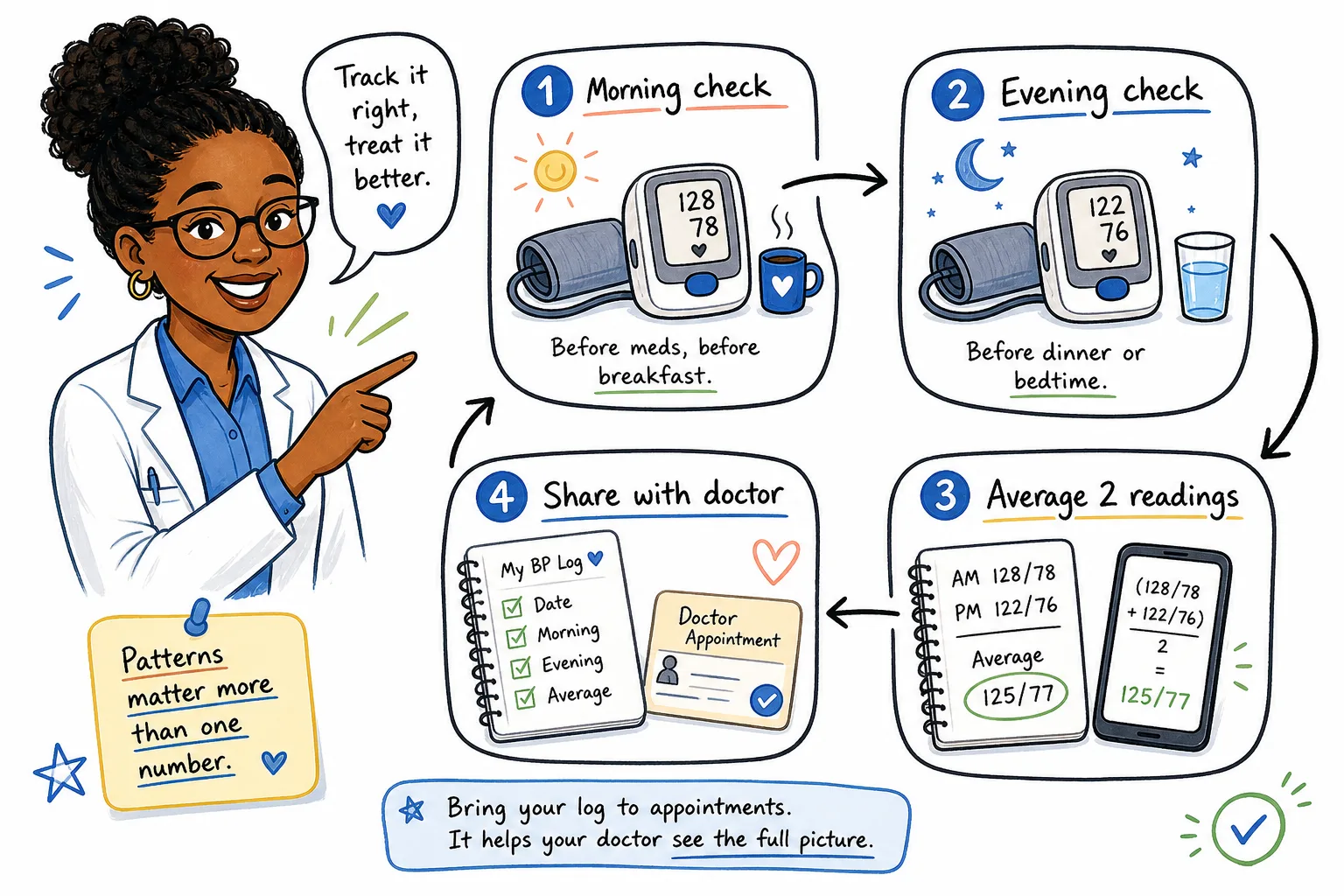
- When to check: If you're monitoring a new or changing condition, check twice daily: once in the morning, before taking medication and after emptying your bladder, and once in the evening, before dinner. If your blood pressure is stable and well-controlled, checking once or twice a week is usually enough.
- How often per session: Take 2 readings, 1-2 minutes apart, and average them. Don't take 5 or 6 readings and obsess over the small differences. Two readings are enough.
- What to record: Date, time, averaged reading, which arm, and context notes. A simple notebook works. A notes app works. Some monitors store readings in memory and can transfer them to an app. Use whatever you'll actually maintain.
- When to review: Look at your log weekly during active monitoring. Are the numbers trending up, down, or staying steady? Share the log with your doctor at every appointment. A written log is more useful than saying, "My blood pressure has been okay."
- When to reduce checking: Once your condition is stable and your medication is working, your doctor may recommend checking less often. Follow their guidance. Home monitoring should support your treatment, not become a source of daily anxiety.
Why home blood pressure readings may not match clinic readings
It's common for home readings to be lower than clinic readings. This is called the white-coat effect: some people's blood pressure rises in medical settings because they're stressed or anxious. For these people, home readings may give a truer picture of their usual blood pressure.
The reverse can also happen. Some people have masked hypertension: their blood pressure is normal in the clinic but high at home. This is harder to detect because routine clinic checks can miss it.
The NIPREGH study of self-measured home blood pressure in an urban Nigerian community found that home readings can be collected reliably over several days and used to understand a patient's usual pattern. Compare morning readings with morning readings, and evening readings with evening readings.
If your home readings are consistently different from your clinic readings, bring your monitor to your next appointment. Many doctors and pharmacists will check your monitor against a clinic-grade device. They may also compare your technique with the clinic standard to identify errors. If one reading surprises you before that appointment, use this guide on what to do after one high blood pressure reading instead of reacting to the number alone.
Device accuracy still matters. Most home monitors don't need regular calibration, but they can drift over time. If your monitor is more than 2 years old or has been dropped, compare it with a clinic-grade monitor during your next visit.
What usually goes wrong during home blood pressure checks
Most inaccurate home readings come from a few repeated mistakes:
- Checking over clothing instead of bare skin
- Using a wrist monitor because it's cheaper
- Talking while the cuff is running
- Crossing your legs
- Checking immediately after walking, climbing stairs, or getting home from work
- Trusting the first reading without repeating it
- Relying on memory instead of writing the number down
- Checking 5 or 6 times a day because one number scared you
How to check blood pressure with irregular heartbeat or for a family member
What to know about blood pressure monitors and irregular heartbeat
If you have atrial fibrillation or another irregular heartbeat, some automatic monitors may not read accurately because they rely on a regular pulse rhythm. In this case, a manual sphygmomanometer — the type with a stethoscope and inflatable bulb — may be more reliable, but it requires training to use correctly. Ask your doctor or a Famasi Care Specialist to demonstrate the proper technique.
When to check blood pressure in both arms
Blood pressure can differ slightly between arms. A small difference of less than 10 mmHg is normal. If the difference is consistently greater than 10-15 mmHg, mention it to your doctor, as this can indicate blocked arteries or other cardiovascular issues. For routine monitoring, pick one arm and stick with it. Most people use the non-dominant arm.
How to help a parent or loved one check blood pressure correctly
If you're monitoring blood pressure for a parent, partner, or other family member, all the same rules apply. Make sure they rest first, sit correctly, and don't talk during the reading. Record their readings in a dedicated log that you can bring to their appointments. If you also manage their refills or medication questions, Famasi Care Specialists can help support the blood pressure routine between doctor visits.
Summary: What to Take Away From This Guide
- Use an upper-arm monitor from a validated brand. Wrist monitors are less reliable.
- Get the right cuff size. A cuff that is too small makes readings appear higher than they are.
- Rest for 5 minutes before checking. No caffeine, smoking, or exercise for 30 minutes beforehand.
- Sit with back supported, feet flat, legs uncrossed, and arm supported at heart level.
- Place the cuff on bare skin, 2-3 cm above the elbow.
- Take 2 readings, 1-2 minutes apart, and average them. The first reading is often artificially high.
- Record every reading with date, time, and context. Bring the log to your doctor.
- Don't check obsessively. A scheduled routine gives better data than constant checking.
Common Questions About Checking Blood Pressure at Home
What is the best time to check blood pressure at home?
Should I take 1 or 2 blood pressure readings?
Is a wrist blood pressure monitor accurate?
Can I check blood pressure over clothing?
Why are my home BP readings different from the clinic reading?
Just for you
References
- Muntner P, et al. Measurement of Blood Pressure in Humans: A Scientific Statement From the American Heart Association. Hypertension. 2019;73(5):e35-e66. Free PMC version.
- Stergiou GS, et al. Home blood pressure monitoring in the 21st century. Journal of Clinical Hypertension. 2018;20(7):1116-1121. PubMed.
- Odili AN, et al. Characteristics of self-measured home blood pressure in a Nigerian urban community: the NIPREGH study. Blood Pressure Monitoring. 2015;20(5):260-265. DOI.
- American Heart Association. Home Blood Pressure Monitoring.
- American Heart Association. The rules for measuring blood pressure — and why they exist. 2024.
- Nigerian Hypertension Society. Guidelines for the Management of Hypertension in Nigeria 2020.
- PASCaR. Nigeria Standard Treatment Guideline for Hypertension.
- Ishigami J, et al. Effects of Cuff Size on the Accuracy of Blood Pressure Readings: The Cuff(SZ) Randomized Crossover Trial. JAMA Internal Medicine. 2023;183(10):1061-1068.