
How to Avoid Running Out of Blood Pressure Medication in Nigeria
Refill gaps are one of the most preventable reasons blood pressure routines break. Build a monthly refill system around your real schedule, budget, travel, and pharmacy access.
- ✓Don't wait until the bottle is empty before planning a refill.
- ✓Use a 7-day refill trigger and link it to a fixed monthly event.
- ✓Build a buffer where possible to protect against stock shortages, travel, and cost timing.
- ✓A written medication list makes refills easier for you, caregivers, and pharmacists.
Your refill routine can make or break your blood pressure control
You've been taking your medication every day, and your readings have been stable. Then you run out on a weekend, during a holiday, when the pharmacy near you is closed, or when money didn't come in when you expected it. You miss 2 days, then 3, then a week. By the time you get a refill, your blood pressure is climbing again, and you have to restart the work of getting it back under control.
This pattern is the norm. Studies from Nigeria suggest that between 60 and 80% of people on blood pressure medication are not taking it consistently, and forgetfulness is the single most common reason. A study from Sokoto found that 35% of non-adherence was caused by forgetfulness alone, and only 8.9% of patients were fully adherent to their medication. A study from Delta State put the poor adherence figure even higher at 80.7%.
Running out of medication is a system failure, not a character flaw. Without a refill system, you're relying on memory, a nearby pharmacy, and available cash all lining up at the same time. When one of those things is missing, the refill doesn't happen and the medication schedule breaks.
A practical refill routine works around your actual month, not perfect memory or perfect circumstances. It's one part of the broader blood pressure management routine: check properly, take medication consistently, refill early, and know when to ask for help.
What refill gaps can do to your blood pressure
Missing a single dose of blood pressure medication doesn't usually cause immediate harm. Most antihypertensive drugs have enough residual effect that one missed day won't spike your reading. The real risk isn't one missed dose but what happens after.
A secondary analysis of the SPRINT trial found that people whose adherence fluctuated between taking and not taking their medication had a 74% higher risk of cardiovascular events compared to people who took their medication consistently. They also had higher blood pressure variability and worse blood pressure control overall. The pattern of starting and stopping mattered more than how many doses were missed in total.
The mechanism is straightforward. Your blood pressure medication works by maintaining a steady concentration of the drug in your body. When you take it consistently, that concentration stays at a therapeutic level. When you stop for a few days, the concentration drops, your blood pressure rises, and your cardiovascular system experiences a pressure surge it had adapted to not experiencing. When you restart, the concentration climbs again. This repeated up-and-down cycle stresses your blood vessels more than a consistently high but stable pressure would.
The numbers make the risk easier to see. A study that analysed missed doses of common antihypertensives found that even 2 days without medication raised systolic blood pressure by an average of 6 mmHg. That kind of movement may look small on paper, but it matters when it keeps happening month after month.
Refill gaps are one of the most preventable causes of these outcomes. You can't control every variable in your health, but you can control whether your medication is in the house when you need it.
Refill gaps to plan around in Nigeria
The global reasons for refill gaps — forgetfulness, cost, side effects, travel — all apply where you live, but a few factors specific to Nigeria make the problem worse:
- Stock availability is unpredictable. A pharmacy that had your medication last month may not have it this month. You may need to visit 3 or 4 pharmacies before finding your medication in stock. When this happens on a day when you're already busy, tomorrow can quickly become next week.
- Cost timing may not match refill timing. Blood pressure medication is a monthly expense, but income doesn't always arrive when the refill is due. That can lead to half doses, skipped days, or waiting until a full refill is affordable.
- Travel separates you from your regular pharmacy. Work trips, family events, holidays, and religious pilgrimages can all interrupt your refill routine. Even when you plan ahead, finding a pharmacy you trust in an unfamiliar area adds friction.
- Managing multiple medications adds mental load. If you also take diabetes medication, cholesterol-lowering statins, aspirin, or supplements, you may be tracking 3 or 4 different refill dates. Forgetting one isn't carelessness; it's a system that wasn't designed for someone managing multiple things at once.
Build a blood pressure medication refill routine around your actual month
A good refill routine is about what you set up, not what you remember. Here's a practical framework.
Step 1: Set your refill date before the bottle is empty
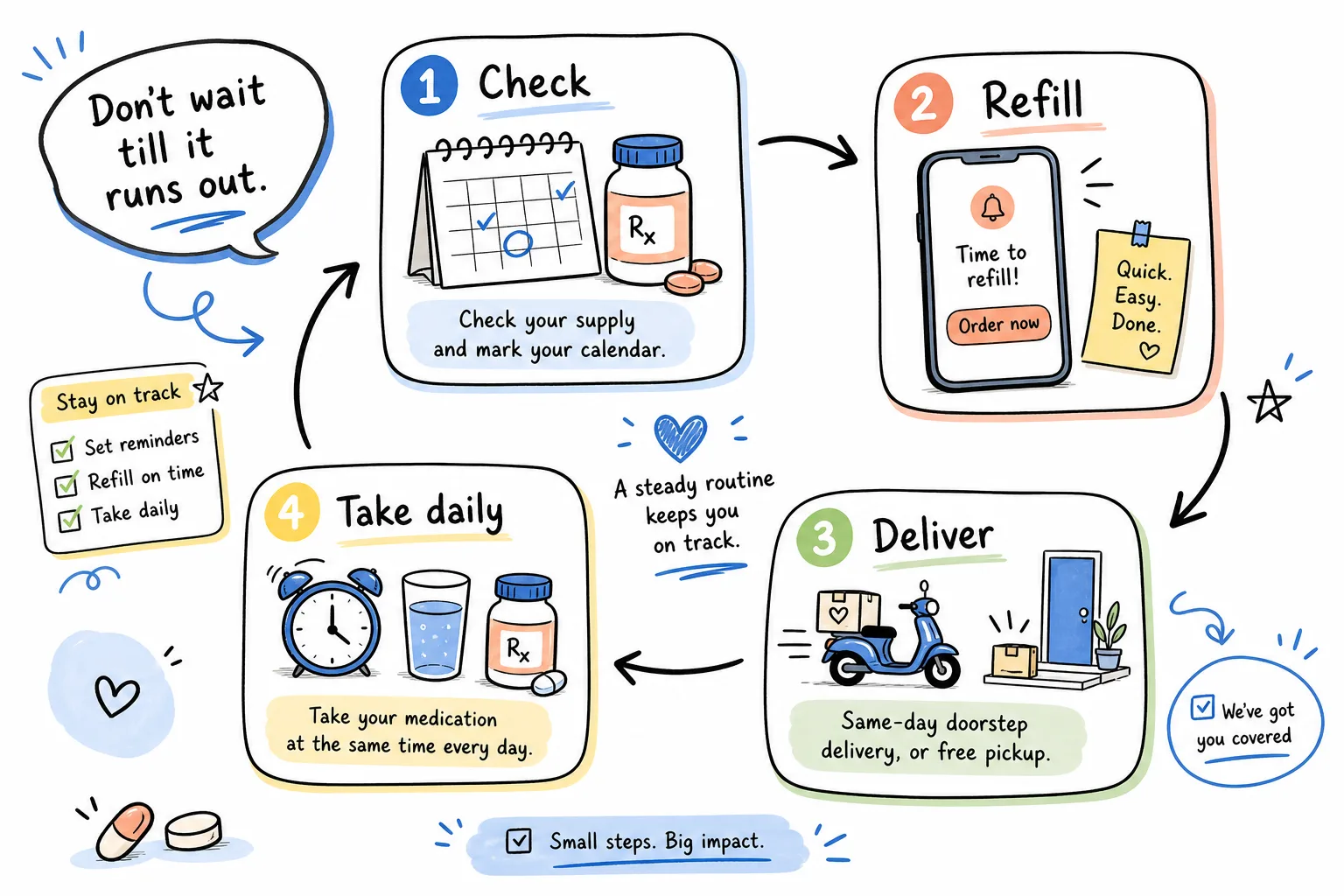
The most common mistake is treating the empty bottle as the signal to refill. By the time the bottle is empty, you've already missed at least one dose. The correct refill trigger is "I have 7 days of medication left," not "the bottle is empty."
Count your tablets when you pick up a new refill. Divide by your daily dose. That tells you how many days a full bottle lasts. Mark the refill date on a calendar, your phone, or a sticky note on your bathroom mirror: "Refill on the 12th" — a specific date, not a vague reminder like "refill when the bottle is empty."
If your prescription is for 30 tablets taken once daily, your refill date is day 23 after you started the bottle. That gives you a 7-day buffer to find the medication, arrange payment, and pick it up before you run out.
Step 2: Link your medication refill to payday or another monthly event
Memory works better when new habits attach to existing ones. Attach the refill to something that already happens every month instead of creating a separate reminder system from scratch.
- Payday refill: If you receive a salary or regular income, set your refill to the same day. When you check your account, check your medication supply.
- Calendar refill: Pick a fixed date every month. The 1st and the 15th are easy to remember. The date you pay rent or your phone bill works too.
- Event refill: If you attend a weekly religious service, a monthly community meeting, or a regular family gathering, use that as your refill checkpoint.
The key is to make the refill automatic by attaching it to something that's already automatic.
Step 3: Keep a 2-week blood pressure medication buffer if possible
If your finances allow it, keeping a 2-week buffer of medication protects you against stock shortages, travel, and timing mismatches. When you pick up a refill, ask the pharmacist if you can fill the prescription a few days early. Over several months, you build up a small reserve that means you never have to refill on an empty bottle.
Some doctors are willing to prescribe a 60-day or 90-day supply instead of 30 days, especially if your blood pressure is stable and your dose isn't changing. Longer prescription durations are associated with better adherence. A 2024 study found that patients who received 90-day supplies had significantly higher adherence rates than those who received 30-day supplies.
If a 90-day supply isn't an option, even moving from monthly to bi-monthly refills reduces the number of times you need to remember and act.
Step 4: Keep a written list of your blood pressure medications and doses
Keep a single list of every medication you take: name, dose, frequency, and refill date. Keep it on your phone or in your wallet. This list does 3 things:
- It tells you, at a glance, what needs to be refilled and when.
- It prevents you from buying the wrong medication at a pharmacy you don't usually visit.
- It gives your doctor or pharmacist accurate information in an emergency or when someone else is picking up your medication.
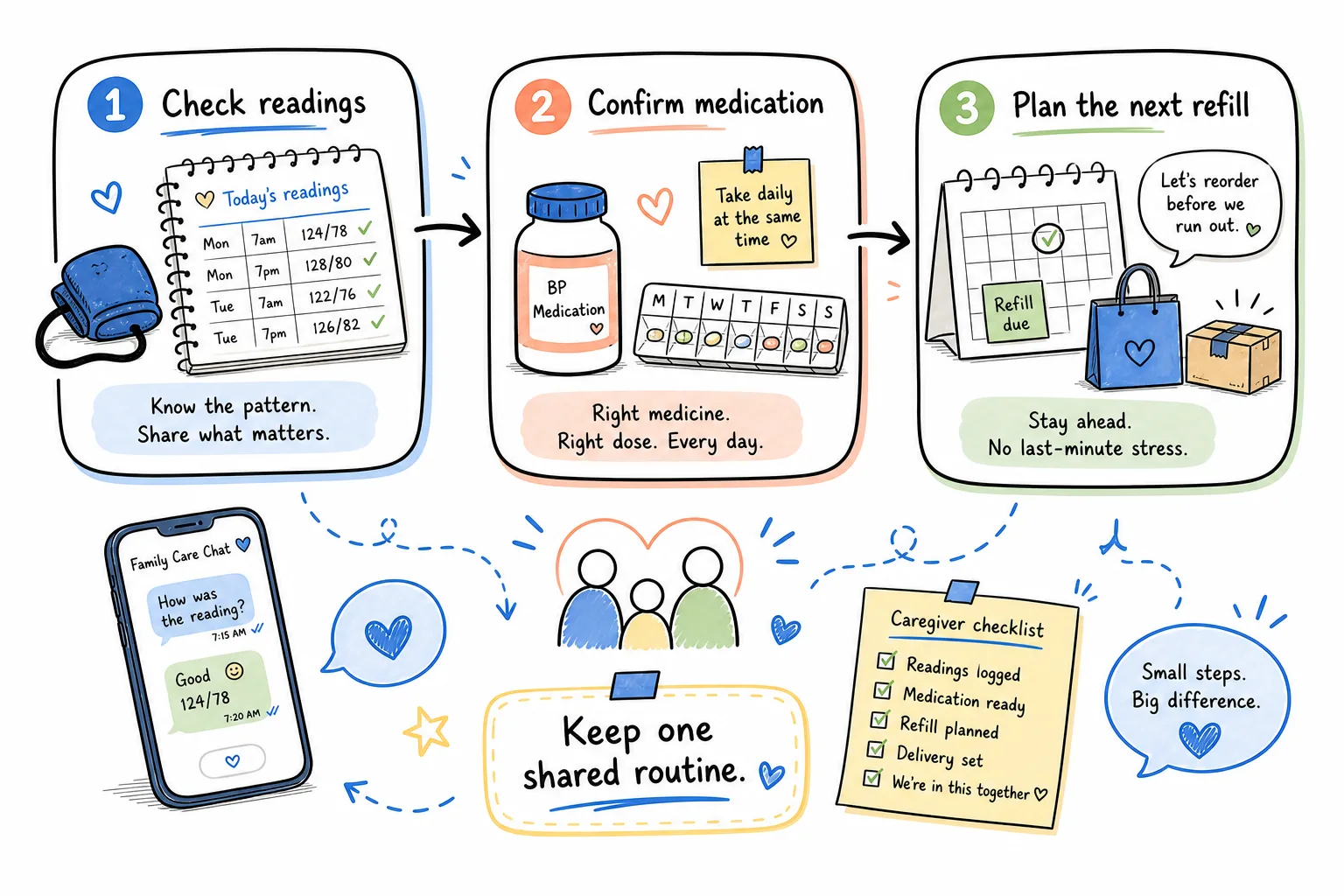
If you manage medications for a parent, partner, or other family member, keep a shared list. One person tracking medications for multiple people is harder than it looks, and a written system removes the mental burden of keeping it all in your head.
Step 5: Have a backup pharmacy plan before your refill system breaks
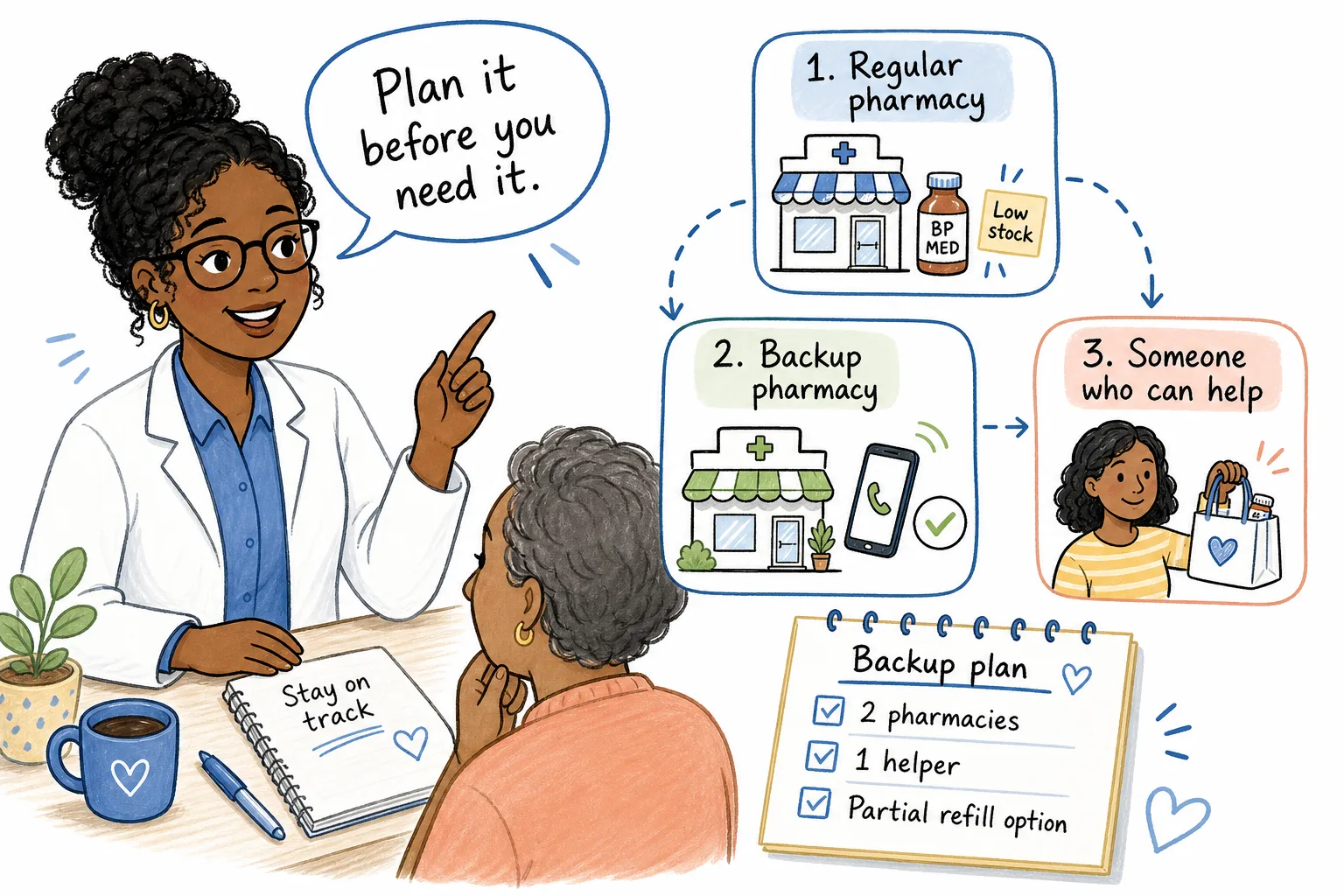
No system is perfect. The pharmacy may run out of stock. You may travel unexpectedly. Your income timing may shift. The question is what you'll do when these things happen.
Your backup plan should answer 3 questions:
- Where else can I get this medication? Know at least 2 other pharmacies near your home or workplace that stock your medication. If your regular pharmacy is out of stock, call the others before you leave the house.
- Who can help? Identify one person — a family member, neighbour, or friend — who can pick up your medication if you can't. Get their agreement in advance, not in the moment of crisis.
- What is the minimum dose I shouldn't go below? If you can't get a full refill, can you get a partial refill to cover the gap? Some pharmacists will dispense a week's supply if the full month isn't available. Ask.
Use refill reminders that actually fit your life
The simplest tool you'll actually use is better than the most sophisticated one you won't. For refill reminders, a phone alarm set to repeat monthly is genuinely effective. Label it clearly: "Refill amlodipine" or "Mum's BP meds." Set it to repeat every 30 days. Test it once to make sure the timing works.
If you prefer a digital system:
- Calendar apps (Google Calendar, Apple Calendar) let you set recurring reminders. Create an event called "Refill BP medication" that repeats monthly. Set 2 reminders: one 7 days before and one on the day.
- Notes apps can store your medication list and refill schedule. A shared note on Google Keep or Apple Notes lets family members see the same information.
- Pharmacy apps from some Nigerian pharmacy chains offer refill reminders and delivery. Check whether your regular pharmacy has a digital ordering system.
- WhatsApp-based services are available through some healthcare platforms. A WhatsApp conversation can handle refill reminders and ordering in the same thread you already use for daily communication.
The right tool is the one you'll actually use. If an alarm works, use an alarm. If a calendar reminder works, use that. Start simple; you can upgrade later.
If you want a pharmacist-supported version of this routine, Famasi Care Specialists can help with refill planning, medication questions, and caregiver coordination.
What if I’m managing refills for my parent or partner?
The refill routine is the same, but the execution needs to account for distance and communication.
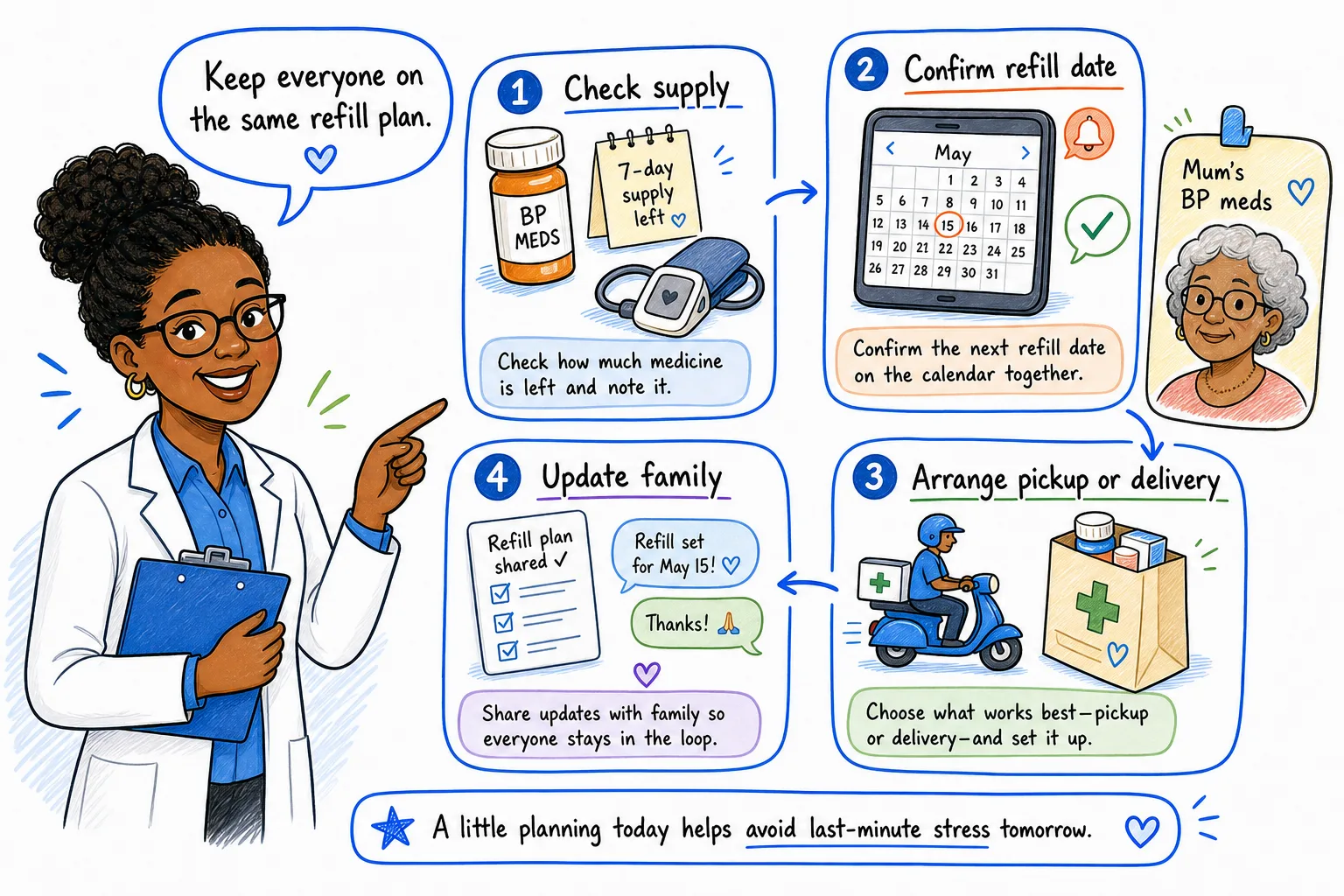
If you live with the person, the simplest approach is to manage their refills alongside your own. Use the same calendar, the same reminder system, and the same pharmacy if possible. Keep their medication in a separate clearly labelled container so you can check supply at a glance.
If you live separately, the challenge is visibility. You can't check their bottle every day. In this case:
- Schedule a weekly check-in call with a specific purpose. Make it about the medication supply, not a general check-in. Set a fixed day and time so it becomes routine.
- Use a shared calendar for refill dates. Both you and the person you care for can see the same reminder. This reduces the chance that both of you assume the other is handling it.
- Enlist local support. If you live in a different city, identify a neighbour, religious community member, or local relative who can check on medication supply and pick up refills. Agree on this arrangement in advance.
- Set up delivery if available. Some pharmacies in major Nigerian cities offer delivery. If your family member can receive deliveries, this removes the physical trip from the refill process.
Managing someone else's medication from a distance is harder than managing your own. Don't expect yourself to remember everything. Write it down, share it, and automate what you can.
What to ask when cost delays your blood pressure medication refill
When the refill is due but the money isn't ready, the safest next move is not to stretch doses quietly. Talk to your pharmacist before the bottle runs out. They may be able to help you find a lower-cost route that keeps treatment going.
A few practical approaches:
- Ask about generic alternatives. Generic blood pressure medications are chemically identical to brand-name versions and are often cheaper. Your doctor or pharmacist can tell you whether a generic version of your medication is available and appropriate.
- Ask about partial dispensing. Some pharmacists will dispense a 2-week supply if you can't afford a full month. This increases the frequency of refills, but it prevents you from going without medication entirely.
- Check whether your HMO covers your medication. If you have health insurance through your employer or a private plan, your blood pressure medication may be covered. Many people with HMO coverage never check whether their chronic medications are included.
- Consider combining your refills. If you take multiple medications, coordinating their refill dates so you pick them all up at once reduces the per-trip cost and makes it easier to budget for a single monthly medication spend rather than multiple smaller purchases throughout the month.
If none of these options work for your situation, talk to your pharmacist. They may know of patient assistance programmes, manufacturer discounts, or other cost-reduction options you haven't heard about. Don't let cost be the reason you stop treatment without exploring every safer option first.
Set up your refill system before the next bottle runs low
Once you have the refill routine mapped out, the next step is making it automatic. Set up recurring refill reminders so the bottle arrives before it runs out and your treatment stays steady.
If you manage blood pressure medication for yourself or someone in your family, that's the kind of system that turns a stressful monthly task into something that happens without thinking about it. If you're deciding whether a structured support plan makes sense, compare this with Famasi Care Plan Services or the Heart Care Plan.
Summary: What to Take Away From This Guide
- Refill gaps are the most common cause of inconsistent blood pressure control. Running out of medication is a system problem, not a personal failure.
- Fluctuating adherence — starting and stopping — is more dangerous than consistent non-adherence. A 2026 SPRINT secondary analysis found 74% higher cardiovascular risk in people with fluctuating adherence.
- Build your refill routine around a specific date, not the empty bottle. Refill when you have 7 days of medication left.
- Attach your refill to an existing monthly event: payday, rent day, or a fixed calendar date.
- Keep a written list of all medications and doses. Share it with family if someone else helps manage your care.
- Have a backup plan: at least 2 pharmacies, 1 person who can help, and a strategy for partial refills.
- Digital tools help, but the simplest one you'll actually use is the right one.
- If cost is the barrier, ask about generics, partial dispensing, HMO coverage, and combined refills before stopping treatment.
Common Questions About BP Medication Refills
How early should I refill blood pressure medication?
What should I do if I miss a refill date?
Can I use another brand if my usual BP medicine is unavailable?
How do I manage refills for a parent?
Can Famasi help with recurring blood pressure medication refills?
References
- Iloh GUP, et al. Medication adherence and blood pressure control amongst adults with primary hypertension attending a tertiary hospital primary care clinic in Eastern Nigeria. African Journal of Primary Health Care & Family Medicine. 2013;5(1):446.
- Adisa R, Ilesanmi OA, Fakeye TO. Treatment adherence and blood pressure outcome among hypertensive out-patients in two tertiary hospitals in Sokoto, Northwestern Nigeria. BMC Cardiovascular Disorders. 2018;18:194.
- Oyibo P, et al. Barriers and enablers of antihypertensive adherence among a Nigerian adult hypertensive population seeking care in public secondary health facilities in Delta State, Nigeria. West African Journal of Medicine. 2025;42(3):240-247. PubMed.
- Wang Y, et al. Fluctuations in adherence to antihypertensive medication and cardiovascular outcomes: a secondary analysis of the SPRINT trial. Hypertension Research. 2026.
- Vrijens B, et al. Adherence to prescribed antihypertensive drug treatments: longitudinal study of electronically compiled dosing histories. BMJ. 2008;336:1114-1117.
- McLaughlin MM, et al. Medication fill duration in pediatric hypertension: adherence, blood pressure control, and disparities. Pediatric Nephrology. 2024;39(9):2717-2723.
- Aminde LN, et al. High burden and trend in nonadherence to blood pressure-lowering medications: meta-analysis of data from over 34,000 adults with hypertension in Sub-Saharan Africa. Journal of the American Heart Association. 2025;14:e037555.
- Nigerian Hypertension Society. Guidelines for the Management of Hypertension in Nigeria 2020.